Wednesday, January 16, 2019

Power in and over Cross-Sector Partnerships: Actor Strategies for Shaping Collective Decisions

As part of a special issue edited by Sandra Schruijer on Dynamics of Interorganisational Collaborative Relationships in the journal Administrative Sciences, our paper on power strategies in collaborative partnerships has been published.

Power in and over Cross-Sector Partnerships: Actor Strategies for Shaping Collective Decisions


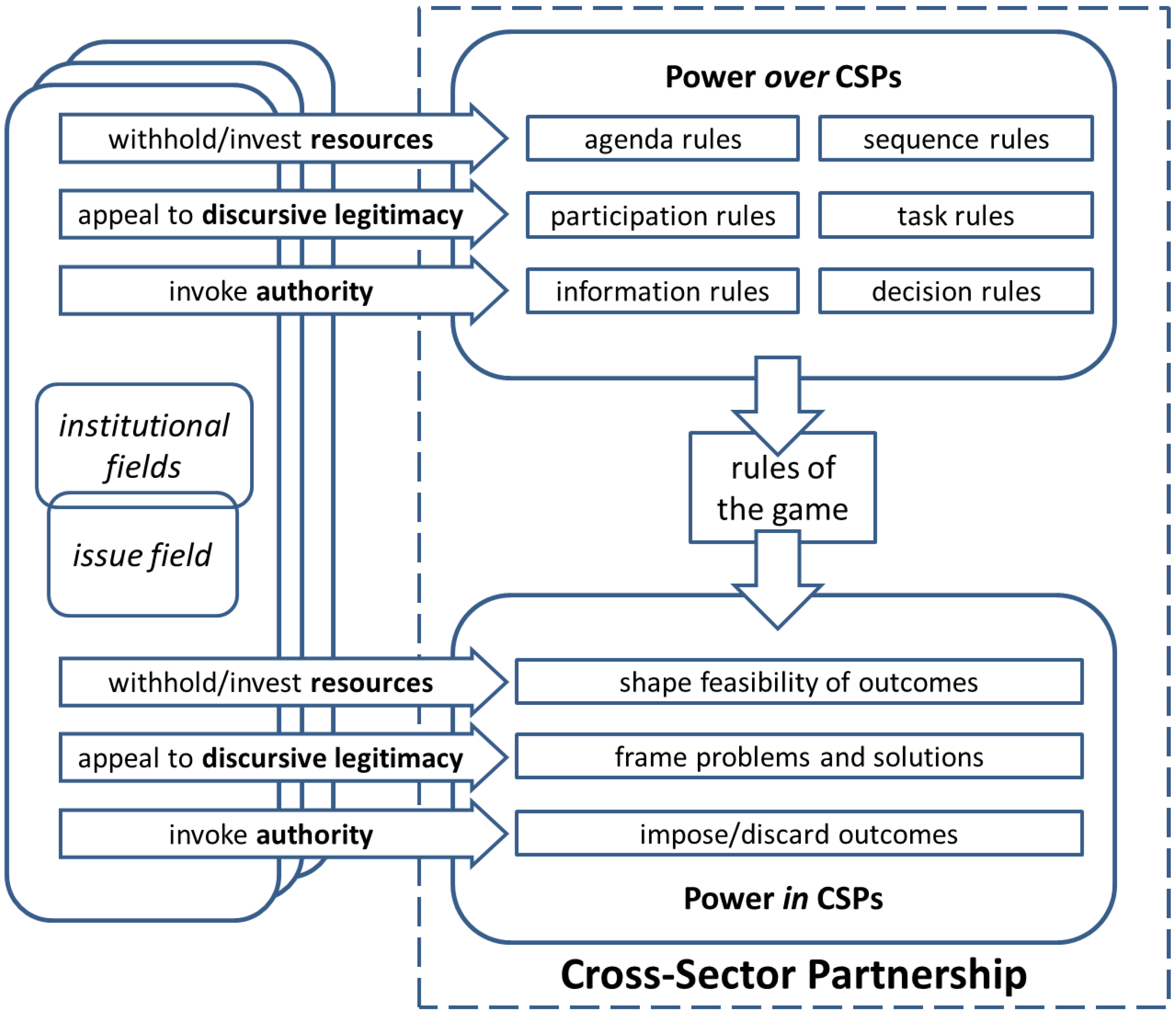
While cross-sector partnerships are sometimes depicted as a pragmatic problem solving arrangements devoid of politics and power, they are often characterized by power dynamics. Asymmetries in power can have a range of undesirable consequences as low-power actors may be co-opted, ignored, over-ruled, or excluded by dominant parties. As of yet, there has been relatively little conceptual work on the power strategies that actors in cross-sector partnerships deploy to shape collective decisions to their own advantage. Insights from across the literatures on multiparty collaboration, cross-sector partnerships, interactive governance, collaborative governance, and network governance, are integrated into a theoretical framework for empirically analyzing power sources (resources, discursive legitimacy, authority) and power strategies (power over and power in cross-sector partnerships). Three inter-related claims are central to our argument: (1) the intersection between the issue field addressed in the partnership and an actor’s institutional field shape the power sources available to an actor; (2) an actor can mobilize these power sources directly in strategies to achieve power in cross-sector partnerships; and, (3) an actor can also mobilize these power sources indirectly, through setting the rules of the game, to achieve power over partnerships. The framework analytically connects power dynamics to their broader institutional setting and allows for spelling out how sources of power are used in direct and indirect power strategies that steer the course of cross-sector partnerships. The resulting conceptual framework provides the groundwork for pursuing new lines of empirical inquiry into power dynamics in cross-sector partnerships.


Dewulf, A., & Elbers, W. (2018). Power in and over Cross-Sector Partnerships: Actor Strategies for Shaping Collective Decisions. Administrative Sciences, 8(3), 43. https://doi.org/10.3390/admsci8030043 (Open Access!)

Special Issue on "Diagnostics of case studies on environmental virtual observatories for connective action"

In the Wageningen Journal of Life Science, a special issue has been published by the EVOCA project.

Environmental virtual observatories for connective action


According to the Preface for the issue:
This Special Issue of NJAS – Wageningen Journal of Life Sciences contains a coherent set of first reports of research carried out within the International Research and Education Funds (INREF) program Responsible life-sciences innovations for development in the digital age: Environmental Virtual Observatories for Connective Action (EVOCA), funded by Wageningen University and Research and its research partners. This program explores whether and how the increased availability of information and communication technologies (ICTs) may be leveraged to support collective management of crops, water resources, livestock, wildlife and (human, animal and plant) diseases in several countries of rural Africa. In relation to this, the programme has a special interest in the potential of new ICT to support the co-creation of relevant knowledge by making community-based environmental monitoring part and parcel of citizen science activities that add value to available information. In addition, it is interested in exploring whether increased connectivity may support new forms of collective mobilization (labeled ‘connective action’) to address environmental challenges. The program aims to develop and test digital platforms that can support such functions in close collaboration with stakeholders and users across six case studies in Ethiopia, Ghana, Kenya and Rwanda.

The special issue includes a introduction paper, led by Katarzyna Cieslik, and a concluding paper, led by Cees Leeuwis.

  • Leeuwis, C., Cieslik, K. J., Aarts, M. N. C., Dewulf, A., Ludwig, F., Werners, S. E., & Struik, P. C. (2018). Reflections on the potential of virtual citizen science platforms to address collective action challenges: Lessons and implications for future research. NJAS - Wageningen Journal of Life Sciences, (July), 0–1. https://doi.org/10.1016/j.njas.2018.07.008
  • Cieslik, K. J., Leeuwis, C., Dewulf, A., Lie, R., Werners, S. E., van Wessel, M., … Struik, P. C. (2018). Addressing socio-ecological development challenges in the digital age: Exploring the potential of Environmental Virtual Observatories for Connective Action (EVOCA). NJAS - Wageningen Journal of Life Sciences, (July), 0–1. https://doi.org/10.1016/j.njas.2018.07.006

My PhD student Andy Nyamekye has also contributed to two papers in the special issue:

  • Nyadzi, E., Nyamekye, A. B., Werners, S. E., Biesbroek, R. G., Dewulf, A., Slobbe, E. Van, … Ludwig, F. (2018). Diagnosing the potential of hydro-climatic information services to support rice farming in northern Ghana. NJAS - Wageningen Journal of Life Sciences, (July), 1–13. https://doi.org/10.1016/j.njas.2018.07.002
  • Nyamekye, A. B., Dewulf, A., Van Slobbe, E., Termeer, C. J. A. M., & Pinto, C. (2018). Governance arrangements and adaptive decision-making in rice farming systems in Northern Ghana. NJAS - Wageningen Journal of Life Sciences, (April), 1–13. https://doi.org/10.1016/j.njas.2018.07.001


Social media hypes about agro-food issues: Activism, scandals and conflicts

Some time ago, Tim Stevens has published a paper on social media hypes as part of his PhD research.

Social media hypes about agro-food issues: Activism, scandals and conflicts

Abstract
Events and controversies in the agro-food domain frequently generate peak selective activity on social media. These social media hypes are a concern to stakeholders because they can affect public opinion and policy, and are almost impossible to predict. This study develops a model for analysing social media hypes and builds a typology to provide insights into the dynamics of social media hypes in the context of agro-food governance. Five cases of peak social media activity in the Dutch livestock sector are analysed along four dimensions: (1) peak patterns of activity, (2) issues and frames, (3) interaction of actors, and (4) media interplay. An analysis of the dimensions and the interrelations across cases shows that social media hypes revolve around activism, scandals, and conflicts – each with characteristic patterns of activity, framing, interaction and media interplay. Hypes do not just result from important events in the sector, but are generated through the use of organizing concepts with a hashtag to evaluate and establish occasions. Peak activity thus revolves around a few themes and is recurrent and judgmental. Moreover, stakeholders play an active role in instigating and framing social media hypes. Our results show the need to adopt a proactive and interactive approach that transcends the view of social media as a mere communication channel to respond in crisis situations.

Stevens, T. M., Aarts, N., Termeer, C. J. A. M., & Dewulf, A. (2018). Social media hypes about agro-food issues: Activism, scandals and conflicts. Food Policy, (February). https://doi.org/10.1016/j.foodpol.2018.04.009


Friday, September 7, 2018

A small wins framework to overcome the evaluation paradox of governing wicked problems

Over the summer our paper on small wins appeared on-line in the journal Policy and Society. Led by Katrien Termeer, and funded by the Dutch Ministry of Infrastructure and Water Management, we are currently conducting an empirical study of the role of small wins in the governance of the transition towards a circular economy, so watch out for more!

A small wins framework to overcome the evaluation paradox of governing wicked problems


Katrien Termeer & Art Dewulf
Policy and Society

Abstract: The evaluation of policy strategies to tackle wicked policy problems inevitably involves a paradox of trying to judge solutions for problems that have no solutions and for which additional efforts might increase the chances of finding better responses. This paper analyzes how the concept of small wins can contribute to evaluating progress in wicked problem areas in a way that energizes a variety of stakeholders instead of paralyzing them and embraces complexity instead of reverting to taming and overestimation. It presents a small wins evaluation framework that is rooted in the underlying policy perspective of making progress through accumulating small wins. It comprises three steps: 1) identifying and valuing small wins; 2) analyzing whether the right propelling mechanisms are activated so as to accumulate into transformative change; 3) organizing that results feed back into the policy process to activate new small wins. This framework will inevitably clash with unrealistic expectations of addressing wicked problems rapidly, radically and comprehensively.

The paper is available open access at: https://doi.org/10.1080/14494035.2018.1497933

What makes long-term investment decisions forward looking: A framework applied to the case of Amsterdam's new sea lock

Earlier this year, Wieke Pot published the first paper of her PhD on forward-looking decisions on water infrastructure. Decisions on water infrastructure are long term decisions and often involve significant policy investments. But are these decisions necessarily forward-looking? In this paper, the concept of forward-looking decisions is proposed: decisions that anticipate and account for uncertain futures. The value of the framework is demonstrated in an analysis of decisions about a new sea lock at IJmuiden in the Netherlands.

What makes long-term investment decisions forward looking: A framework applied to the case of Amsterdam's new sea lock


Abstract: Long-term investments challenge decision makers to look into the far future. Existing future studies often build upon a rational idea of decision making that does not help to explain why decision makers anticipate the future. In addition, existing studies do not provide a clear definition of what is considered as “forward looking”. This article proposes a framework that can be used to evaluate and explain for what reasons and based on what criteria decision makers take forward-looking investment decisions. We apply this framework to a specific decision-making case about a Dutch sea lock, making use of interviews (n = 16) and a content analysis of primary documents (n = 430). We find that not all investment decisions are necessarily forward looking. Secondly, we conclude from our case that decisions became forward looking because administrators used scenarios, visions, and flexible solutions to build support, avoid political risks and comply to formal rules. Scenario developers and urban planners could therefore involve administrators in early stages of the decision-making process to increase their awareness of the future towards which they are steering and provide them with alternative future paths. Furthermore, they could identify and use relevant institutional rules with forward-looking features to stimulate forward-looking decisions.

The article is available (open access) at https://doi.org/10.1016/j.techfore.2018.01.031

Pot, W. D., Dewulf, A., Biesbroek, G. R., Vlist, M. J. van der, & Termeer, C. J. A. M. (2018). What makes long-term investment decisions forward looking: A framework applied to the case of Amsterdam’s new sea lock. Technological Forecasting and Social Change, 132(January), 174–190.